
- This topic has 2 replies, 3 voices, and was last updated 4 years, 6 months ago by
Lauren Bundy.
-
AuthorPosts
-
-
October 14, 2021 at 2:04 pm #8400
Izzy Charlton
ParticipantAccording to Erikson’s theory of psychosocial development, the students in my class should be approaching the identity vs. role confusion crisis. I have noticed that many of the students are experimenting with how they present themselves, especially through clothing. The dress code at the high school is very simple: “Students are responsible to dress in such a manner that is not disruptive nor likely to disrupt the learning environment, is not a health and safety hazard, is not obscene, is not sexually explicit, discriminatory or associated with threat/hate groups, including gangs.” There are no arbitrary rules about length of skirts, spaghetti straps, crop tops, hats, etc. This dress code is simple, yet effective. It is important to make sure the learning environment is not disrupted, but you also don’t want to suppress the students’ sense of identity. Allowing students freedom to explore their clothing options is a great way to encourage identity formation. In terms of my teacher in particular, I have noticed a positive and identity affirming environment in his classroom. When asking students what they thought of Mr. Wiebe, the general consensus was that he was “a pretty cool dude.” He is great at positively interacting with students, complimenting them on their basketball game or their shoes. I noticed during homecoming week, he especially complimented the few students who had gone all-out in dressing up. He creates a safe environment in which students feel safe to express themselves, through their clothing but also in what they have to say. He connects with students who usually do not have a voice in the classroom, which I think is a great way to help develop identity for those students.
As for myself, I think I fall into Marcia’s category of Identity Achievement. I experienced some tough crises growing up and I am finally in a place where I am happy with myself. Being raised in a conservative, Catholic household really forced me to come to terms with who I am and what I value. Around middle school, I started to realize that there were parts of me that didn’t align with the expectations my family had. I spent years questioning whether there was something wrong with me, as my upbringing made it impossible to accept myself as I was. After spending about 2 or 3 years unsure of my sexual identity, I came to the realization that I was bisexual. But even after I had made this realization, I did not tell anybody in my life for over a year. I was terrified of it defining me and I did not want to commit to being “out”, which I think is a sign I was in the moratorium stage. It was not until about a year and a half later that I felt comfortable enough to tell my closest friends. Even then, they were the only people I told (news travels quickly in small towns and I didn’t want to risk my family finding out). Thankfully, Carleton was a chance to reintroduce myself to the world and I didn’t have to hide my sexuality from people. I feel that I have finally come to terms with my sexuality and let go of the religious beliefs that were instilled in me. It was a difficult process that I do not wish upon anybody, but I am ultimately grateful for it. It is a great relief to finally be comfortable with who I am.
One moment that I noticed this week was when a student referred to himself using the r-slur. Obviously, it is not acceptable to use that word and I am not condoning his use of it. However, I think his usage of it really illustrates his feelings toward his school and towards himself. This is a student that has consistently been quite apathetic in the classroom, often spending the lab time talking to other students without writing a single word down in his lab notebook. One day, he walked in and made a comment to Mr. Wiebe that “it’s a world record that he’s been in school for six days in a row.” He has been struggling to show up to class consistently, but I don’t think he is stupid by any means. It seems he is still dealing with the industry vs. inferiority crisis, as he automatically labels himself as stupid because he isn’t performing work like other students. It is tough to see a 9th grader give up on school because he thinks he is stupid, when his school experience is likely impacted by factors far beyond his control. Based on my interactions with him, I don’t think he is stupid by any means. When I was working with him, he was able to calculate results when given the formula and data to do so. However, because he does not care about lab, he never takes his own data. When you don’t write anything down in your lab notebook, it is impossible to have anything to calculate or analyze. At the end of class, Mr. Wiebe went to go talk to him about his work. Mr. Wiebe was transparent, telling the student he needed to do the lab to pass this class, since it’s worth 35% of the grade. He was realistic, but not overly stern. The message was clear, and he gave the student the opportunity to make up the work later. I think it is crucial to give students 2nd chances, so I appreciate that Mr. Wiebe did that. I really hope Mr. Wiebe’s connection with this student is enough to give him some hope of succeeding in school. As of right now, it seems his view of school is pretty bleak.
Fortunately, there was a student who I was able to help. He usually hangs out with the aforementioned apathetic student, as they are in the same lab group. With this student, I’ve noticed that he also tends to brush off school work. However, I have noticed a certain optimism that allowed me to eventually get through to him. When the students were working on their postlab calculations, he was sitting at his desk, not doing any work. I approached him, asking him if he had any questions. Unlike the apathetic student, he did indicate he needed help. He told me that he didn’t know how to do percent error, since he had been gone the day they did it in class. I started explaining how to do it by pointing to the formula projected on the board, but he didn’t seem to be able to understand what I was referring to. I wrote the formula on a piece of paper on his desk, and that seemed to clear up some confusion right away. Here’s the formula for reference:
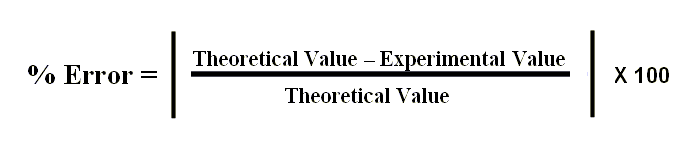
When first looking at the formula, it can be overwhelming. Not only are there mathematical components to it, but there is some substantial vocabulary as well. Even if a student knows how to do math, the terms often trip them up, as they aren’t sure which values are theoretical and which are experimental. In his classroom, Mr. Wiebe uses the term “true value” rather than “theoretical value,” which I think clears up some of the confusion. It’s one small step of scaffolding that can really help immensely. When explaining the formula to the student, I told him that you really only need two values and you plug them into the formula. Breaking the formula down really seemed to help the student gain some confidence, as it looks a lot more intimidating than it actually is. I asked him to find the true value, which he needed a little guidance to find. Then, I asked him to find the experimental value, which he found quickly. Once you have those two values, you just plug them in and calculate it out. He was able to do this on his own with only one correction from me (a misplaced division sign). Mr. Wiebe had them do percent error twice, one for sand concentration and one for salt. After the student had gotten a result successfully with guidance, he was able to do the next one entirely independently. He thanked me, excited to understand something that seemed so intimidating. This was probably my favorite moment of tutoring so far, since it is not often that I get to work 1-on-1 with students. It was exciting to be able to directly see such a positive impact on student learning, especially for a student that is usually withdrawn.
-
October 14, 2021 at 8:29 pm #8401
Kara Sun
ParticipantHi Izzy, I enjoyed reading your story about being able to help the student who was stuck on calculating percent error. It seems like you really caught him in his ZPD, when he was struggling to figure it out himself (especially because he missed the class when it was taught) but was able to successfully find the percent error with your help, and later on his own! That seems like a great example of social learning. I am also interested by your observations about students building identity. You identify that one student (the one who often misses class) seems to still be in the industry vs. inferiority stage as he is not very confident in his own abilities. I wonder how this overlaps with his identity building – has he decided that part of his identity is that he is not “good” at school? Can Erikson’s stages overlap in such a way? Or maybe they’re not actually overlapping, but rather this student has come into the identity building stage feeling inferior? I’d be interested to see what you think about these questions.
-
October 15, 2021 at 4:07 pm #8403
Lauren Bundy
ParticipantI really appreciate your comments on how students use clothing as a means of expressing identity, Izzy. I’ve noticed the importance of clothing in my classroom as well, not only in how students present themselves, but also in how they interact with each other. It’s been quite uplifting, actually! I don’t think a French 4/5 class has gone by when I haven’t witnessed an interaction where students compliment each other on what they’re wearing. Clearly I’m observing a well-dressed class! It’s refreshing to see students build each other up based on how they express themselves; I feel like media depictions of high schools so often skew the other way. From what I’ve seen, students are supportive of other students’ identity development. For instance, when one student was talking about her plans to visit New York City (I think for a college visit, but I didn’t catch the whole conversation), another student told her, “I can totally see that for you!” These students are at a pivotal moment in their lives, with college just on the horizon for many, so I’m enjoying seeing how aesthetics, self-expression, and peer interaction are playing a role in their self-discovery.
-
-
AuthorPosts
- You must be logged in to reply to this topic.