
- This topic has 1 reply, 2 voices, and was last updated 4 years, 5 months ago by
Logan Robinson.
-
AuthorPosts
-
-
November 1, 2021 at 1:15 am #8553
Angela Ellis
ParticipantMrs. Talbot has created a very supportive and encouraging environment in her classroom. There was an example in the online textbook about a student smiling back to the teacher who smiles at them. I believe this is a similar case with Mrs. Talbot. When students enter her room, they know, based on their previous experiences in her classroom, that it’s not only going to be okay, but it will most likely be enjoyable. Each day is a bit different, so every time students enter her class, they have a sense of excited anticipation of what is to come. For example, Mrs. Talbot may have fun music playing, or maybe she’ll have the disco ball out, or she might be distributing candy to demonstrate a math concept. Students enter the classroom curiously, eager to pay attention to see what fun they will be having. In behaviorism lingo, the classroom is the stimulus that prompts students to be ready to pay attention. As a result, students are in a productive mental space when Mrs. Talbot begins teaching.
Mrs. Talbot encourages me to give students immediate feedback while they are working on their homework. She tells me to just interrupt them and let them know which problems are right and which are wrong. When students have independent work time after the lesson, Mrs. Talbot and I circle the room, answering students’ questions and correcting their work in real-time. This gives students immediate feedback as to how they are doing. When students are told they’re doing great, they are motivated to keep going. This positive feedback serves as a reinforcement for children to encourage children to keep going.
Bandura’s Social-Cognitive theory focused on self-efficacy and self-regulation. Self-efficacy is defined as “personal beliefs about one’s capabilities to be successful in tasks with novel or ambiguous elements” (350). It is very obvious that the students in Mrs. Talbot’s advanced math class have a lot more confidence in their math skills than students in the regular class. One way that Mrs. Talbot encourages learning through a cognitive approach is through her use of the Frayer Model. Through this model, students learn about new math concepts by connecting the new material to things they already know.
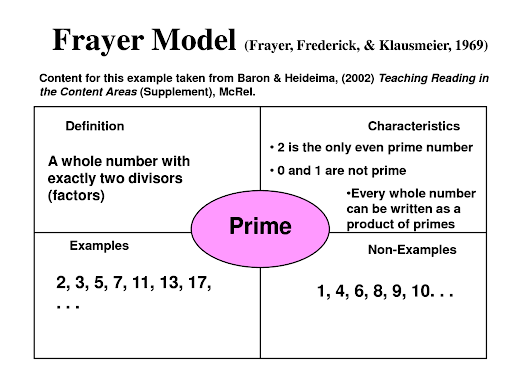
Instead of giving a convoluted definition, Mrs. Talbot works through the box above, getting students’ input to fill it in.
I believe that I am a cognitivist at heart, but I do not want to discredit the importance of some of the aspects of behaviorism. However, I feel that the social-cognitive theory allows for more nuance in learning. Learning happens in so many forms with so many people in so many different circumstances. Watson’s claim that he can turn a baby into a thief, gunman, builder, or climber based on using just behaviorism techniques seems unrealistic. I believe an individual’s personality can have a big impact on how they learn. Behaviorism tends to discredit individual characteristics.
This past week, Mrs. Talbot gave me worksheets to hand back to two students. She told me to let the students know what they did wrong and to watch them as they correct it. I realized that day how bad I am at correcting people. I don’t want to be mean. I’m rarely in a space where it’s my job to tell people what to do; it felt very strange to have this authority. It will take time for me to get used to this position. I am realizing it’s important that I see beyond just me correcting the students. My advice can be helpful to the students, even if they don’t want to hear it. Telling people that they’re wrong can be productive, even if it’s uncomfortable for me.
Before ninth-period starts, Mrs. Talbot has a prep period. Every time, she is working up to the bell to prepare for her next class. I remember this happened with a few of my teachers in high school. I wonder why this is the case. It seems as though Mrs. Talbot does not have enough time to get ready for her next class. I know this is not because she’s wasting time. It’s clear during class that she is very intentional about maxing out every minute. If she has too much on her plate, what are her options? Do less for the students? Hire another teacher? The former is not a real option, and the latter, hiring a new teacher, seems unfeasible. To end on a low note, are teachers forced to accept that they will be chronically overworked?
-
November 2, 2021 at 4:46 am #8570
Logan Robinson
ParticipantAngela,
Thanks for your insightful comments about Mrs. Talbot and her classroom environment. Your wide variety of examples in fun rewards that she presents to her students makes me want to be a part of the class! I think it’s really great that a lot of those come as the students walk in, as I think you’re dead on that the students are ready to learn as a result. (maybe a bit of backwards reinforcement) I also think immediate feedback, as we have discussed in class is a great classroom tactic. In the classroom I tutor we do similar things to the Frayer Model, the KWL charts.
I also think it is great that your tutoring has helped you realize how you fit into authority. I have this problem at times, but recognizing the benefits are a good step! But, sadly I also think you’re right that teachers have a ton on their plates and may just be chronically overworked.
-
-
AuthorPosts
- You must be logged in to reply to this topic.