
- This topic has 1 reply, 2 voices, and was last updated 4 years, 5 months ago by
Kara Sun.
-
AuthorPosts
-
-
November 8, 2021 at 4:59 am #8604
Logan Robinson
ParticipantSophia and I work in the same fourth grade classroom, so we decided this week would be a good week to do a joint blog post. We worked together on summarizing and analyzing the lesson plan. At the end we each added some of our own observations.
Objectives:
Identify lines of symmetry in a variety of objects and shapes
Create symmetrical objects with blocks
Work on both tactile and abstract concepts within symmetry
Warm Up:
The kids came in from Music, snacks in hand. Ms. McLaughlin allotted a few minutes for the students to consume their snacks and wind down back into the classroom setting. Since we came in during the second half of their math lesson, the students already had a math-specific warm-up at the beginning of the day.
Activities:
Ms. McLaughlin split the class into their math groups, which are determined by skill. The groups rotated to each activity and spent approximately 20 minutes at each station.
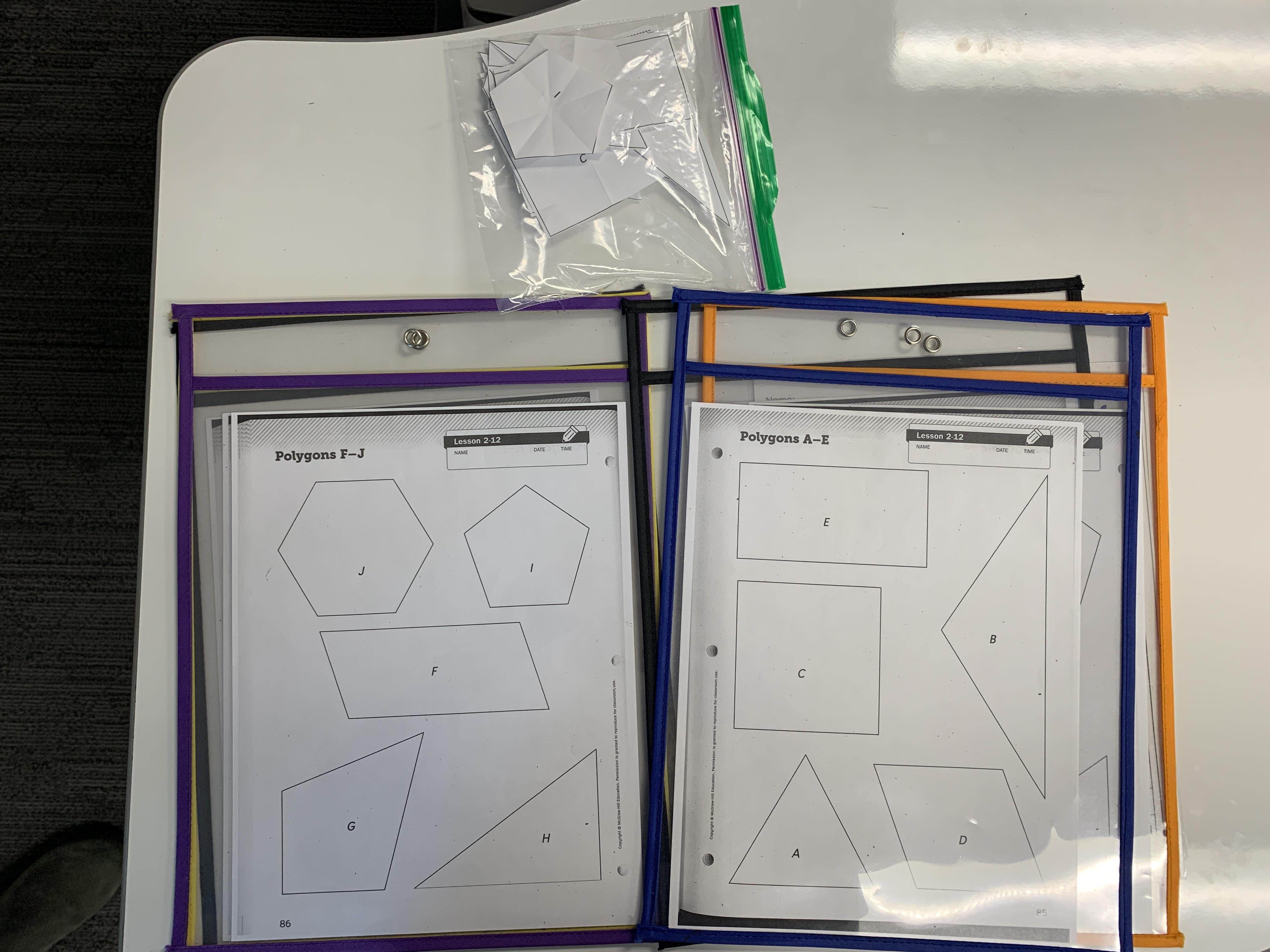
The first group of five headed for the back table, where we and the teacher were standing. This activity was the first in the sequence, and it focused on lines of symmetry. Mrs. McLaughlin handed out clear plastic slip pouches and dry erase markers. In each pouch there was a double-sided sheet of paper with the activities on them. The first side consisted of half of a star with a line down the middle. Students were asked to use their dry erase markers to fill out the other side, aka finish drawing the star. Once the students were done with that they flipped the pouches over to reveal four images of easily recognizable objects. They were asked then to find and draw all of the lines of symmetry for each object. The next activity was similar, just with a variety of different shapes instead of objects. The images below are of this activity.
To give the 4th graders a visual aid for how lines of symmetry work, we cut out the shapes on the paper and folded them to see if the edges lined up with each other. For the equilateral triangle, no student immediately understood that there were three lines of symmetry, they only saw one. However, when we showed them the cutout of the triangle and rotated it, some quickly understood that there were three lines. However, it took this tactile experience with the shape — they could not quite understand the concept abstractly.

Another group went to the floor, where they sat with a plastic box full of colorful tiles of different shapes (the ones with the white rhombus, green equilateral triangle, orange squares, etc.). These students had already completed the symmetry sheet activity and now were tasked with creating symmetrical designs, such as flowers, or other geometric images. We were both impressed by the intricate designs the kids made, and for the most part, they were symmetrical. However, even some of the “smarter” students had a hard time visualizing symmetry. Many designs looked like they would be symmetrical, but were thrown off by the rhombuses that didn’t line up with the correct edges when folded in half.
After the groups completed the paper and block assignments, they returned to their desks with their iPads to work on IXL, a computer-based math program. This was an independent activity, but Ms. McLaughlin put a tracker of the kids’ progress on the board (see picture below).

Motivational Strategies:
The rotation oriented groups allowed students to see their progress in understanding lines of symmetry. At first, they couldn’t accurately find the number of symmetry lines, but by the end they had developed tools to be able to both find and create shapes with symmetry. They seemed proud of themselves when they began to get the numbers correct. Additionally, the group setting allowed students to work together and feel even more intrinsically motivated to further their learning.
Closure:
Although this was not part of the lesson, to close the math portion of the day the students completed a multiplication quiz. The quiz is part of a district-wide and mandated assessment with the goal of students completing 50 basic multiplication problems in three minutes. Mrs. McLaughlin didn’t emphasis this particular quiz, as they have been working on this with their own weekly quizzes to track their progress. Then, to transition from Math to English, Mrs. McLaughlin read aloud to the students. Currently, the book entitled, “Restart”. During this time, they are allowed to take out doodle notebooks or whatever they need to transition to the new subject and readjust their focus.
Follow Up:
It was not clear to us whether or not they will continue working specifically on symmetry in future classes. From our experience in elementary school, we remember working with symmetry quite frequently, particularly with the blocks they used. Thus, we assume this will be a continuous activity.
Mrs. McLaughlin seemed to be very intentional in her lesson planning, as each activity built on the skills learned in previous activities. For example, the students were able to better perform in the shape building exercise as a result of the paper activity. Furthermore, within the paper activity the students started with very basic, obvious tasks and developed into more advanced, abstract tasks. We both saw the limits and benefits of skill-based instruction groups. For the first group we observed (the lowest level math group), there was no student who understood the concept of symmetry well enough to explain it to the other kids. Because of this, the teacher was the primary guide. However, in the second group we observed, understanding differed more, which resulted in one student getting the chance to explain lines of symmetry of an octagon to her group. The first group just wrote the line of symmetries on the pouches. However, Mrs. McLaughlin recognized the second group could understand the connection between the printed pages and the workbook, so they were asked to additionally write the numbers in their workbooks. This shows how Mrs. McLaughlin recognizes and accommodates various students’ learning levels. We felt the lesson was quite successful, as it was easy to see the kids working to process and then comprehend symmetry. The explicit structure of the lesson plan made this possible. Food for thought: to what extent do math groups help and hinder the students? Perhaps the kids that are good at math would feel annoyed if they had to work with kids that didn’t understand as well, but it might help the kids that are struggling to have a peer MKO…
Sophia: For the past few weeks, the students have been working on a fun math assignment similar to color by number, but which requires them to solve multiplication problems. Most students have already finished at least one of the sheets (there are multiple designs, such as a lion, elephant, and other animals), but Allie (the 4th grader that I (Sophia) work with most frequently) is still working on her first sheet. Ms. McLaughlin handed me the sheet and asked me to help her complete five rows, which is 100 problems. We went into the hallway, colored pencils in hand. The teacher had told me that Allie should just put a line of the corresponding color in the square and go back later to fill it in because that would be much more efficient than carefully coloring in all the squares. Allie wasn’t interested in completing any of the worksheet, and it was a lot of effort to get her to focus. I ended up individually reading out loud “5×7?… 11×12?… 3×5?…” Sometimes she quickly answered, sometimes she ignored me, and often she didn’t connect the answer with the color the answer corresponded with. Additionally, at first, she was adamant about coloring in the squares individually. I proposed the line method and that we could come back later and color it in but she refused. A few minutes later, something changed and she adopted the slash method. However, at this point, she was no longer interested in coloring in the squares and so by the time we had finished, the sheet was covered in brown, orange and, blue lines. But, that’s getting ahead of ourselves. Like I said earlier, it took a lot of effort to get Allie just to answer the multiplication problems out loud. However, after 40 or so problems, she started singing. I didn’t know how to stop her. She was being creative and making her own music. How long was I supposed to let her sing? At Greenvale, probably not very long or more likely, probably not at all. However, maybe at a school like Prairie Creek, Allie would be allowed to sing. All these questions floated through my mind, and then I realized that maybe I could combine math and singing for Allie! “Hey, Allie, I have an idea! Can you see out the math problems as you work on them?” Without any questions asked, Allie started singing. “2×10, 20, that’s for me… blue. 3×5, 15, that’s for me,” she sang. I no longer had to read her the problem and wait tediously for her to answer. She did everything on her own accord.
Logan: Sophia and I made a couple of interesting observations while helping teach the paper activity on symmetry. The first was about the varied levels of understanding between the first and second group. The first group consisted of students who Mrs. McLauglin had identified as kids who would and were struggling with the concepts. They could not figure out how to draw the other half of the star correctly and really struggled for a while. While, once they understood the assignment, they could tell what they were drawing was incorrect, they couldn’t figure out how to fix it. It was really interesting to see the difference then when the second group came they all drew really nice half stars. This occurred for most of them before we had even finished handing out the materials, much less explain the task. It was a very interesting difference that we both were slightly surprised by the evident disparity. On a different note one of the objects for the second part of the paper activity was a turtle. Students in both groups were very distraught by drawing a line of symmetry down the turtle, as well as seeing the paper cut out of the turtle be folded in half in the demonstration we did. It really shocked us how adamant they were about not “hurting” the turtle. This potentially speaks to some of Kohlberg’s thoughts on moral reasoning development, but it was a really interesting occurrence.
Another thing I wanted to share was about the student that I typically spend the most time reading with during the week. He has been having a tough time focusing recently, as I think there are some other things going on outside of the classroom. When I walked over to visit him he was under his desk with his head in his hands. I slowly approached and sat down next to him, asking if he was ok. He immediately shuffled around and excitedly made space for me to sit and read with him. I asked what we were reading today and he pulled out a book called “Tops and Bottoms”, which once we started reading I recognized. The book is about a bear and a family of hares who continually trick the bear into letting them harvest his crops and take the actual crop while leaving him with the leaves or roots. The family of hares consists of 15 baby hares and 2 parents, which the boy was quick to share with me. Each page has a different number of hares on it and often there are a couple hidden ones. He was more excited about counting and then determining which of the various hares was the “most hidden”. Typically he would then read the page after we had assessed this, but he started getting carried away with the hares and would move to the next page without reading. I would say “wait! I think we forgot something”, and he would quickly go back and mumble through the page to get to the next one. However, since I continued to let him count and assess he started being more inclined to read too. Sophia and I were comparing this to her story about Allie’s singing math problems. We were thinking about how it worked really well to allow the student to do what they wanted in order to also get them to complete the task effectively. However, I keep thinking about how it would be such a challenge to allow every one of the thirty kids to do their own thing to get them to do what you want them to. My forever struggle with individualization and efficiency or completion.
-
November 8, 2021 at 11:37 pm #8610
Kara Sun
ParticipantHi Sophia and Logan,
I loved reading your blog!! It was super interesting. The first thing that I wanted to ask about was the teacher putting students’ progress on the board in front of everyone. I was thinking about how I would feel if this happened in my class – if I wouldn’t care because I was used to it, or if I would compare myself to others, or if it would motivate me to work hard to show my progress. I was wondering why you thought that tactic didn’t go in the “motivation” part of the lesson plan? How did you see it affecting students?
Secondly, I thought your stories about working with students individually were amazing! Both of your abilities to embrace student passions/wonderful ideas to help them learn are impressive. I could see it being easy to immediately tell a student to stop singing, or stop counting rabbits, because they need to focus on the assignment. But in reality those tendencies could be connected to the assignment in a way that increases student intrinsic motivation to learn! So cool!
-
-
AuthorPosts
- You must be logged in to reply to this topic.